

How Do Narwhals Communicate? Sound, Precision, and Survival in the Arctic Ocean
How Do Narwhals Communicate?
Narwhals rely on sound more than sight, especially during deep dives and under Arctic ice, where visibility is limited.
In the Arctic, light is limited for much of the year. Water can be dark, ice can block visibility, and depth adds another layer of opacity. In this environment, communication and perception depend on acoustics.
Narwhals use sound to navigate, to hunt, and to maintain awareness of their surroundings.
For a broader understanding of how this fits into their biology, see narwhal facts.
Echolocation: Precision in Darkness
Echolocation is the core of narwhal communication.
Narwhals emit short, directional clicks that travel through the water. When these clicks hit an object—such as prey or ice—they bounce back. The returning signal carries information about distance, size, and structure.
This allows narwhals to build a detailed picture of their environment without relying on vision.
Echolocation is especially important during deep dives, where light does not reach. It is also critical when navigating beneath ice, where openings to the surface may be limited.
To see how this supports feeding behavior, explore what do narwhals eat.
Beyond Clicks: A Range of Vocalizations
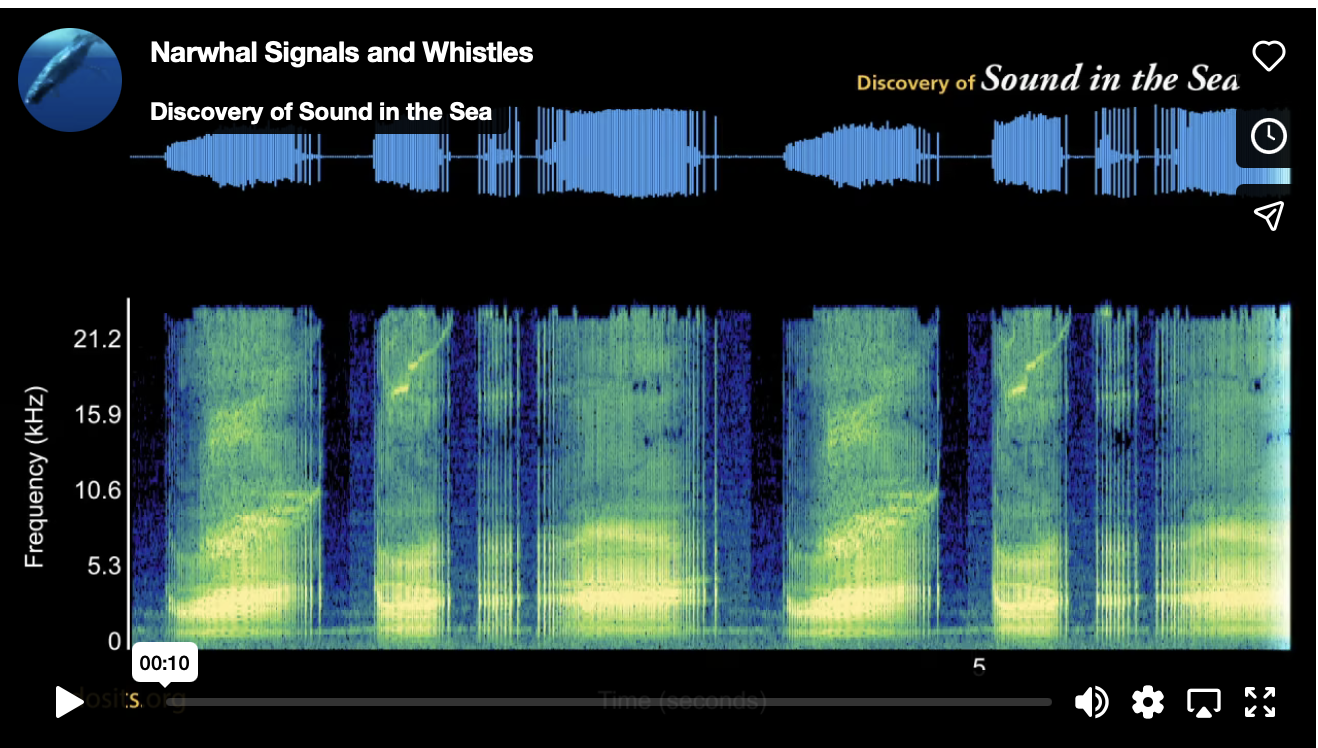
Courtesy of Ari Daniel Shapiro and the Woods Hole Oceanographic Institution.
Narwhals produce more than just echolocation clicks.
They also emit:
whistles
pulsed calls
tonal sounds
These are thought to play a role in social interaction, although much remains unknown. Compared to species like dolphins, narwhal vocal behavior is less studied, in part because of the difficulty of observing them in their natural environment.
What is clear is that sound serves multiple functions, not just navigation.
Communication Within a Pod
Narwhals are often found in groups, sometimes small and sometimes numbering in the dozens.
Maintaining cohesion in these groups requires some form of coordination. Acoustic signals likely help individuals stay aware of one another, especially in conditions where visibility is low and movement is constrained by ice.
The structure of the Arctic environment means that communication must work at both short and longer ranges, depending on context.
Sound in an Ice-Dominated Environment
The Arctic is not an empty acoustic space.
Ice reflects, absorbs, and distorts sound. Narrow channels, shifting floes, and varying depths create a complex environment for acoustic signals.
Narwhals appear well adapted to this. Their echolocation is precise, and their ability to navigate tight spaces under ice suggests a high degree of sensitivity.
These acoustic behaviors only make sense within the Arctic environment that narwhals inhabit. To understand that environment , see where do narwhals live.
Narhwal Communication and Risk
Sound can also create exposure.
In open water, vocalizations may make narwhals more detectable to predators such as orcas. This creates a trade-off between communication and concealment.
There is evidence that narwhals reduce vocal activity in certain situations, suggesting that silence is also part of their strategy.
Human Noise and Disruption
The Arctic is becoming louder.
Shipping routes, industrial exploration, and other human activities introduce low-frequency noise into the water. These sounds can travel long distances and interfere with the frequencies narwhals use.
This can affect:
echolocation accuracy
group communication
navigation
This sensitivity to sound is one reason why narwhals can’t live in aquariums, where acoustic conditions are entirely different from the Arctic. For a deeper look at this issue, see how human noise disrupts narwhal behavior.
Communication as a Survival System
For narwhals, communication is not a single function. It is a system that supports:
navigation through ice
detection of prey
coordination within groups
awareness of threats
It operates continuously and under conditions that leave little room for error.
A System We Are Still Learning to Understand
Narwhals remain difficult to study. Much of what we know about their communication comes from indirect observation and acoustic monitoring.
What is clear is that their reliance on sound is fundamental and closely tied to the environment they inhabit.
To understand how communication aligns with seasonal movement, explore narwhal migration patterns.
